Born on a Wednesday Night? Rahu and the Two Faces of Wednesday in Thai Astrology
Wednesday night births in Thai astrology belong to Rahu. Explore the 6 p.m. split, Rahu's story, the forest Buddha, weekday color and number.
Only Wednesday splits into two
Of the seven weekdays in Thai astrology, only Wednesday divides into two branches. From 6:00 a.m. to just before 6:00 p.m. it is “Wednesday daytime”, guarded by Mercury (พระพุธ), and from 6:00 p.m. to just before 6:00 a.m. the next day it is “Wednesday night”, guarded by Rahu (พระราหู).
The paper from Thammasat University describing Thai day counting gives the same division: whereas other days bind day and night together as one weekday, Wednesday is held by Mercury from 6:00 to 18:00 and by Rahu from 18:00 to 6:00 the next day. This is why horasat has eight stars, not seven.
Putting the calendar and the Thai day side by side
Let us pin it down with concrete times. In horasat the day begins at 6:00 a.m., not at midnight.
Until 5:59 a.m. on a calendar Wednesday, it is still Tuesday’s day. From 6:00 a.m. to 5:59 p.m. on Wednesday it is Wednesday daytime, Mercury’s time. From 6:00 p.m. on Wednesday until 5:59 a.m. on the calendar Thursday it is all Wednesday night, Rahu’s time. Someone born at 3:00 a.m. on Thursday is a Thursday on the calendar but a Wednesday-night person.
So a friend born on Wednesday daytime and a friend born on Wednesday night have different stars despite sharing a Wednesday. If the birth time is unknown, we do not collapse it into a single Wednesday branch but show every possible category.
What kind of figure is Rahu?
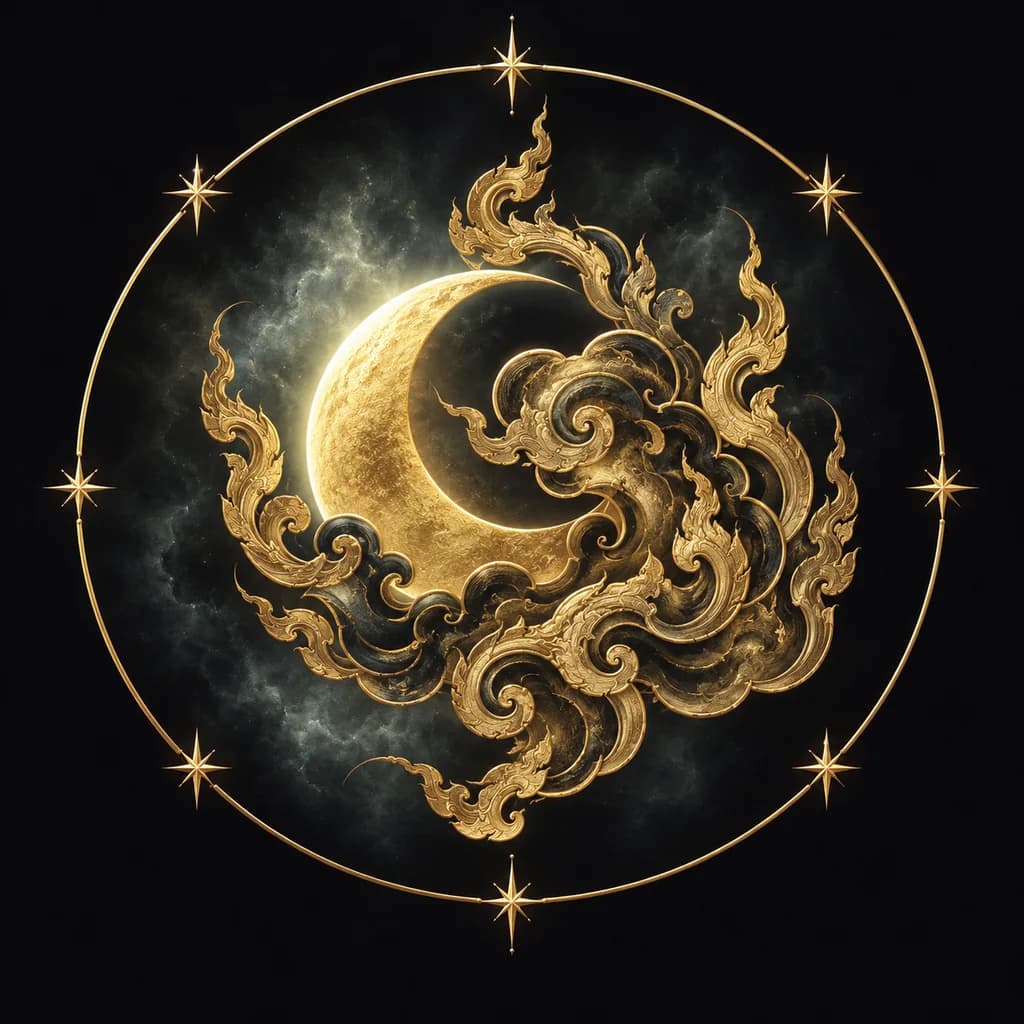
Rahu is an unusual figure even among the nine stars. He is not a visible body like the Sun or Moon but the “shadow star” that explains solar and lunar eclipses. In the myth, Rahu is the asura who tried to secretly drink the nectar of immortality, was caught and had his body severed; only the head remains, and it chases the Sun and Moon. Eclipses are the result of that pursuit.
In Thailand Rahu is portrayed with a mix of fear and reverence. Thai Wikipedia says he is depicted with a bronze-tinged blue body, often as a head or upper body swallowing the Moon, and it notes that offerings and rites for him are held. He is not only a fearsome image: in the Buddhist texts he takes refuge in the Buddha and releases the Sun and Moon.
The Wednesday-night Buddha is in the forest
In the weekday Buddha tradition, Wednesday night belongs to the Buddha of Parileyyaka Forest (ปางป่าเลไลยก์). When the monks were quarrelling, the Buddha withdrew alone into the forest to rest, and an elephant and a monkey waited on him attentively. Where the Wednesday-night branch is easily read as dark, this Buddha sits quietly, having stepped back from the quarrel.
You need not force this story onto the character of Wednesday night. But picturing “time to step back from the noise and rest quietly” makes a good reflective question. From what commotion do I need to step away and rest right now?
Wednesday night in color and number
The color of Wednesday night is often given as a dark color leaning toward gray or black, clearly distinct from the green of Wednesday daytime. Some sources list neighboring shades such as deep purple or silver as well, so it is easier to understand it as “the dark color family of the night sky” than to nail it to one.
The number is 8. When numbers are given to the eight stars in thaksa, Rahu is number 8, written ๘ in Thai numerals. In the eight-position thaksa layout, someone born on Wednesday night puts Rahu in the first position, “The People Around Me”, then continues with Venus, the Sun, the Moon, Mars, Mercury, Saturn and Jupiter. Jupiter ends up in the last position, “what to watch carefully”.
Light reflection questions for Wednesday-night people
Here are some questions to ask yourself after reading about the star. None has a right answer. The first is “When do I concentrate most quietly?” If you read about a night star, picture the time and place where you feel most at ease. The second is “From what commotion do I want to step back?” Recalling the forest Buddha, think of a relationship or task you want to sort out.
The third is “What part of me is invisible but certainly there?” Rahu is a bodiless shadow star, unseen but revealing his presence through eclipses. If there is a taste or thought you have not shown but cherish, try bringing it out once this week. These are good questions even without astrology, but the frame of a star story makes them easier to begin.
Talking it over with a friend
If you have a friend born on Wednesday, ask casually whether it was day or night. That the same Wednesday splits into two stars makes a surprisingly good conversation topic. If your friend does not know the time, asking family or finding a birth certificate becomes a small event of its own. Imagining “is this friend Mercury by day or Rahu by night?” while sharing stories is fun too.
How to take the “two faces”
The two faces of Wednesday can be read as the daytime and nighttime sides of one person, or as an interesting device showing that even the same day has different stories depending on the hour. Either way, it does not mean a fixed personality or destiny.
You may come across explanations online that read Wednesday-night people as “dark” or as people who “should be careful”. Horasat does not read it that way. Shadows and eclipses are heavenly phenomena that pass and return, and the story of Rahu is the old imagination woven around them. Use the story of your star only as one lens for looking at yourself anew.
Frequently asked questions
If I was born at 2:00 a.m. on a Wednesday, what day am I?
The Thai day begins at 6:00 a.m., so 2:00 a.m. on a calendar Wednesday belongs to Tuesday’s day. At that hour you read as born on Tuesday.
If I was born in the early hours of Thursday, am I still Wednesday night?
Yes. Until 5:59 a.m. on the calendar Thursday it is Wednesday night. Thursday’s day begins at 6:00 a.m.
Is being born on Wednesday night a disadvantage?
No. Horasat’s stars are not a ranking to compare against each other but different starting points for different stories.
Sources consulted
External references used while writing this guide. The summaries and interpretation are by the Horasat editorial team.